Managing fixed assets effectively is essential for organisations that want to maintain accurate records, control operational costs and improve accountability. However, many businesses still rely on spreadsheets, manual records and periodic physical checks to track their assets.
These methods can become increasingly difficult to manage as organisations expand, acquire more equipment or operate across multiple locations.
A structured fixed asset tracking system helps businesses maintain better visibility over their assets, from initial registration to physical verification and eventual disposal.
For Malaysian organisations looking to strengthen asset management practices, combining a reliable asset register, barcode or RFID technology, and asset management software can make a significant difference.
What Is Fixed Asset Tracking?
Fixed asset tracking is the process of identifying, recording and monitoring an organisation’s physical assets throughout their useful life.
These assets may include:
- Office furniture and equipment
- Computers, laptops and IT infrastructure
- Medical equipment and hospital assets
- Machinery and manufacturing equipment
- Hotel furniture, fixtures and equipment
- Vehicles and operational equipment
An effective asset tracking process records essential information such as the asset number, description, location, assigned department, custodian and current condition.
With accurate and accessible records, organisations can make better decisions about asset utilisation, maintenance, replacement and budgeting.
Common Challenges in Fixed Asset Management
Without a structured tracking process, organisations may encounter several challenges.
1. Inaccurate Asset Records
Asset records can become outdated when equipment is transferred between departments, relocated or disposed of without updating the asset register.
Over time, these discrepancies make it difficult to determine whether recorded assets are still available and correctly assigned.
2. Missing or Unlocated Assets
When asset locations and custodians are not properly recorded, employees may spend considerable time searching for equipment. In some cases, organisations may continue maintaining records for assets that can no longer be located.
3. Time-Consuming Physical Verification
Manual asset verification can require teams to inspect individual items, compare them against existing records and document discrepancies.
For organisations with thousands of assets across multiple buildings or locations, this process can be resource-intensive.
4. Limited Visibility Across Departments
When different departments maintain separate spreadsheets, asset information can become fragmented. Management may struggle to obtain a consistent view of asset locations, ownership and status.
5 Ways to Improve Fixed Asset Tracking and Verification
1. Maintain a Centralised Asset Register
Establish a single, reliable source of asset information. Each asset should have a unique identification number and complete records, including its location, custodian and relevant financial information.
Regular updates help ensure that the register reflects the organisation’s actual asset position.
2. Implement Barcode or RFID Asset Tagging
Asset tags provide a practical way to identify and verify physical assets.
Barcode technology allows staff to scan individual assets using compatible scanning devices, while Radio Frequency Identification (RFID) can support faster identification of multiple tagged assets, depending on the equipment and environment.
The appropriate technology depends on the organisation’s asset volume, verification frequency, operating environment and budget.
3. Conduct Regular Physical Asset Verification
Physical verification helps confirm whether recorded assets exist, where they are located and whether their details match the asset register.
A structured verification exercise can identify missing assets, unrecorded assets, incorrect locations, duplicate records and other discrepancies requiring investigation.
4. Standardise Asset Movement Procedures
Asset transfers should be documented whenever equipment moves between departments, buildings or locations.
Clear procedures for transfers, assignment changes and disposals help maintain accountability and reduce differences between physical assets and recorded information.
5. Use Fixed Asset Management Software
Dedicated software can bring asset information, identification, tracking and verification activities into a more structured process.
Instead of relying entirely on separate spreadsheets, organisations can improve the consistency of their records and make asset information easier to access for operational and reporting purposes.
Why Malaysian Businesses Should Consider a Digital Asset Management System
As organisations grow, managing assets manually becomes increasingly challenging. A digital system can help establish consistent processes across departments, branches and facilities.
For businesses in Malaysia, an effective fixed asset management solution can support:
- Improved asset visibility: Access asset information in a structured system.
- More efficient verification: Use barcode or RFID-enabled workflows where appropriate.
- Better accountability: Maintain clearer records of asset locations and custodians.
- Improved record accuracy: Identify discrepancies for review and reconciliation.
- Stronger asset governance: Establish consistent procedures for asset registration, movement and disposal.
The objective is not simply to digitise existing records. It is to establish a reliable process that connects the organisation’s physical assets with accurate, up-to-date information.
How MyAsset365 Supports Fixed Asset Management
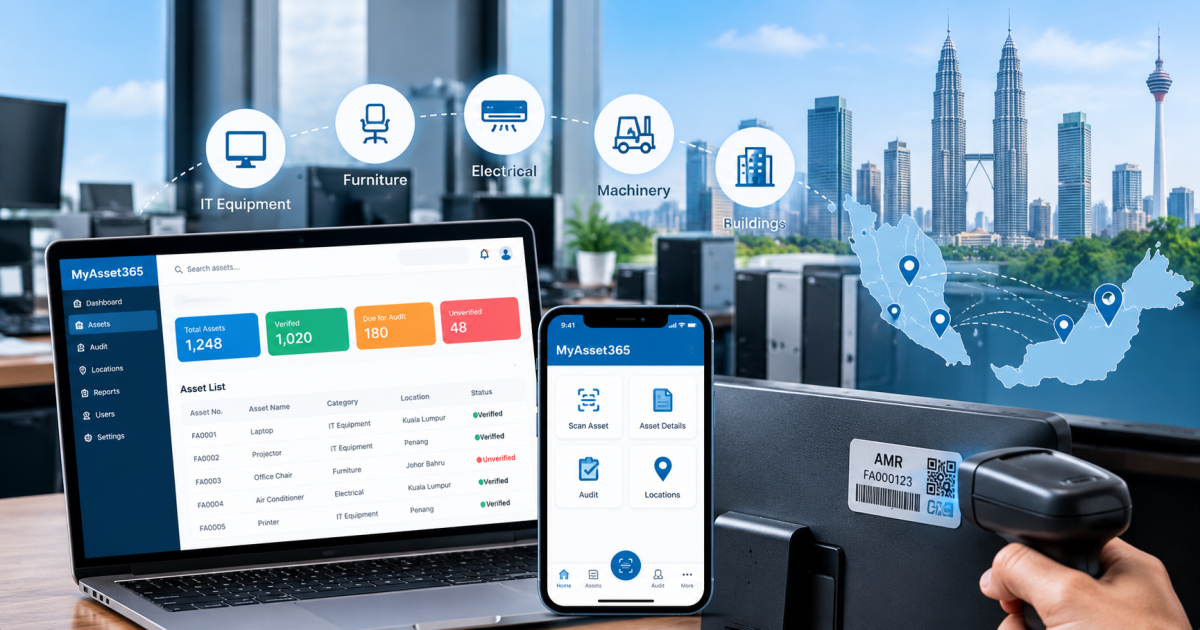
AMR’s MyAsset365 Enterprise Cloud Asset Management System helps organisations modernise their fixed asset management processes through a structured digital approach.
By supporting asset management and tracking workflows, MyAsset365 helps organisations work towards better asset visibility, more organised records and more efficient verification activities.
Whether an organisation is improving an existing asset register or implementing a more structured asset management process, choosing an appropriate system is an important step towards stronger asset control.
Conclusion
Effective fixed asset tracking requires more than maintaining a list of equipment. Organisations need reliable records, appropriate identification technology, consistent asset movement procedures and regular physical verification.
By combining these practices with a suitable fixed asset management system, Malaysian businesses can improve asset visibility, reduce manual administrative work and strengthen accountability.
Looking to improve your organisation’s fixed asset tracking and verification process?
Discover how AMR’s MyAsset365 Enterprise Cloud Asset Management System can support your organisation’s asset management needs.
Contact AMR today to learn more.
Email: sales@amr.my
Website: https://amr.my/